Europe’s radical right and Russia: meetings, money and political influence
Party loans, cooperation agreements, media operations and disputes over aid to Ukraine: the record differs sharply from country to country. A documented chronology explains what connects these cases — and where the evidence stops.
20 September 2026 · Historical cases dated individually
The relationship between Russia and Europe’s radical right is not explained by a single secret meeting or one common ideology. It includes public party agreements, an acknowledged bank loan, appearances at international gatherings and alleged covert media funding. These connections can provide political access, visibility and financial resources. But the documents support different conclusions in each case: an invitation is not a payment, a programme is not an intelligence instruction, and an indictment is not a conviction.
Eight countries · eight distinct records
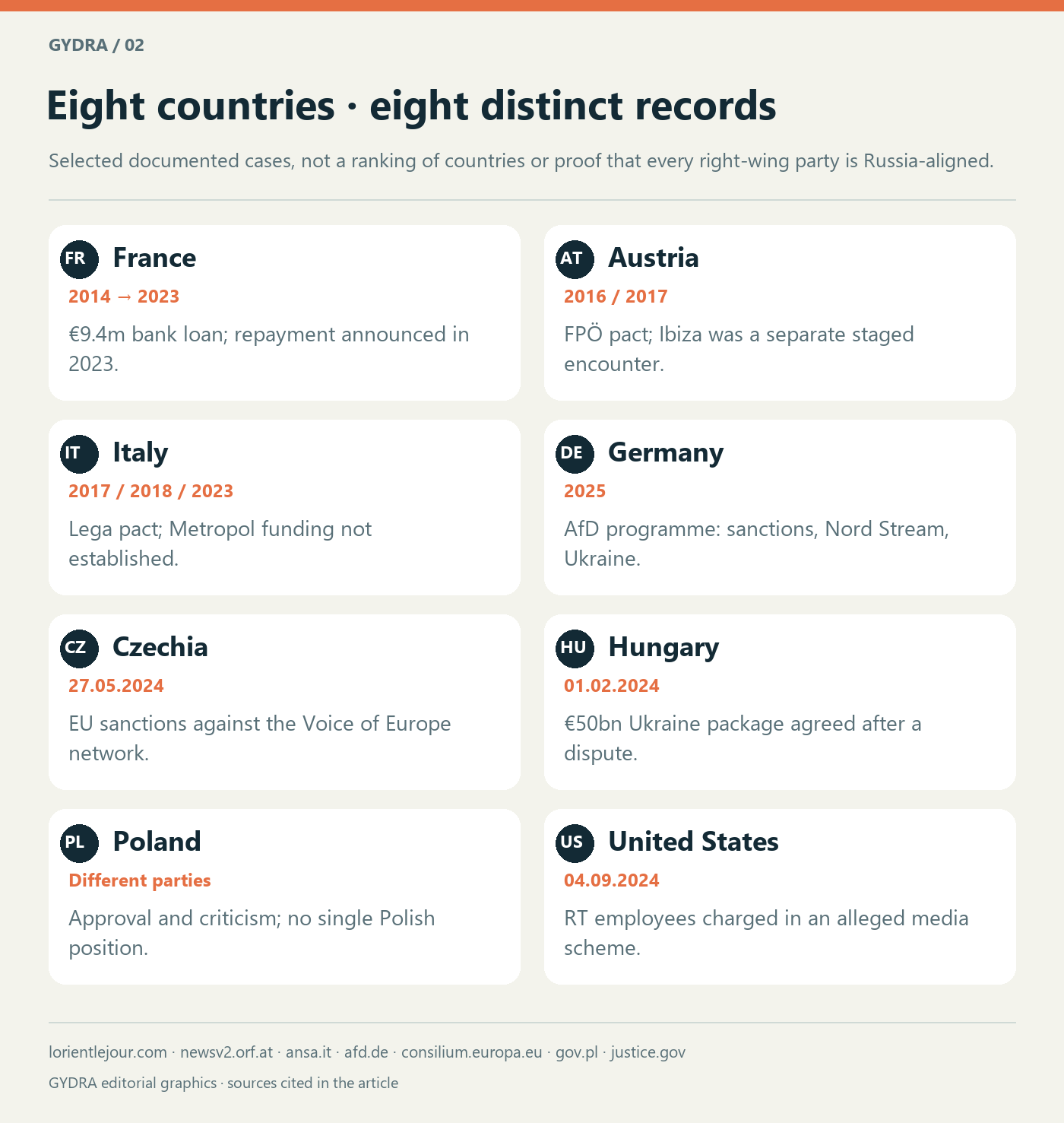
Selected documented cases, not a ranking of countries or proof that every right-wing party is Russia-aligned.
France: a bank loan, not an abstract allegation
In 2014, the National Front, later renamed National Rally (RN), obtained a €9.4 million loan from the First Czech-Russian Bank. The party said French banks had refused it credit. The transaction created a real creditor relationship, distinct from speculation about ideological sympathy. RN announced repayment in September 2023. That repayment matters: the historical loan should not be described as an indefinitely continuing debt. Nor does the loan alone establish that Moscow dictated every subsequent party position. 1
Austria: a signed pact and a separate staged encounter
On 19 December 2016, FPÖ signed a cooperation agreement with United Russia in Moscow. This was a public institutional relationship with Russia’s ruling party. The Ibiza affair was different: a conversation filmed in July 2017 became public in May 2019. Heinz-Christian Strache discussed possible political and media assistance with a woman posing as a Russian investor’s relative. The recording precipitated his resignation. It documents a willingness to discuss influence, but the staged encounter is not proof of an actual Kremlin payment. 2 3
When and where the meetings took place
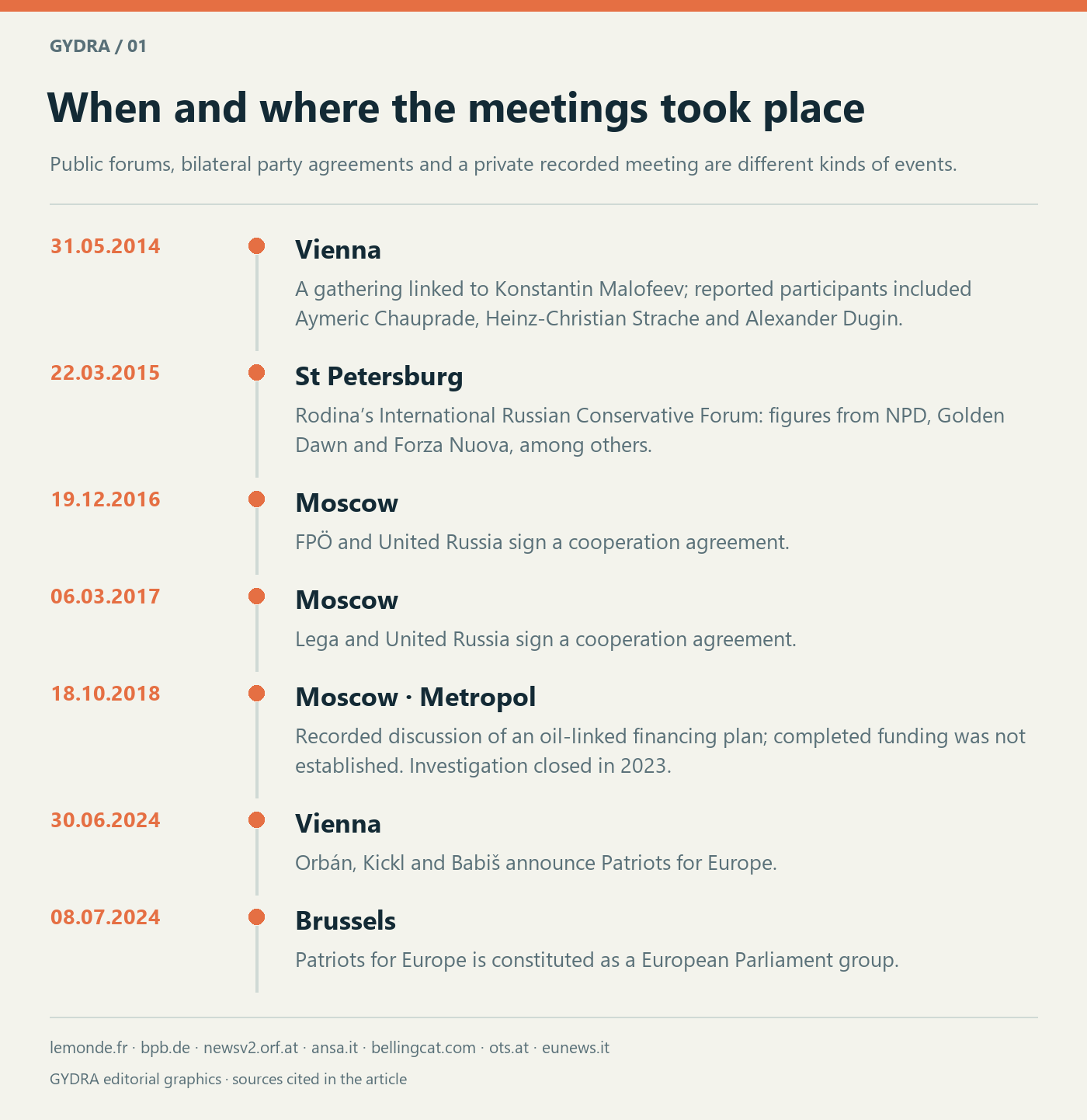
Public forums, bilateral party agreements and a private recorded meeting are different kinds of events.
This chronology shows a change of scale and format rather than one uninterrupted chain of command. The 2015 forum brought together radical figures on a Russian stage. The 2016 and 2017 agreements formalised bilateral party relations. The 2018 recording concerned a proposed financial mechanism. The 2024 European Parliament grouping was an electoral and parliamentary alliance. Treating all seven events as Kremlin-run congresses would erase what the sources actually establish. 4 5 2 6 7 8 9
Italy: a party agreement, an unrealised oil scheme and a counterexample
Lega signed a cooperation agreement with United Russia on 6 March 2017. A separate meeting at Moscow’s Metropol hotel on 18 October 2018 involved Gianluca Savoini and discussions of an oil transaction intended to generate funds for the party. Reporting on the recording made the case public in 2019. The Italian investigation was closed in April 2023; a completed funding transfer was not established. It would therefore be misleading to turn a discussed scheme into money proven to have reached Lega. Italy also shows why the whole right cannot be treated as one bloc: Giorgia Meloni’s government signed a bilateral security cooperation agreement with Ukraine on 24 February 2024. 6 10 11 7
Germany: AfD’s own programme is the strongest starting point
AfD’s 2025 federal election programme calls for lifting economic sanctions against Russia, repairing Nord Stream and a neutral Ukraine outside NATO and the EU. These are directly attributable proposals with consequences for Europe’s policy towards Moscow. They do not, on their own, prove foreign payment. AfD must also be distinguished from the German NPD: Udo Voigt’s participation in the 2015 St Petersburg forum was not an AfD delegation. Mixing the two parties produces a false continuity of personnel and organisation. A more specific case concerns Petr Bystron: on 6 May 2025, the European Parliament waived his immunity in connection with an investigation into suspected payments linked to Voice of Europe. Bystron denies the allegations. The procedural decision is not a verdict; it cannot be generalised to every AfD member. 12 5 13 14
Czechia: Voice of Europe and a formal EU sanctions decision
On 27 May 2024, the EU sanctioned Voice of Europe, Viktor Medvedchuk and Artem Marchevskyi. The Council described the outlet as a channel for disinformation and financial resources intended to remunerate propagandists and build influence among European party representatives. This is an official, documented administrative finding. It does not make every person interviewed by the outlet a paid agent, and it must not be presented as a criminal conviction of all politicians associated with the platform. 15
Hungary: influence through EU decision-making
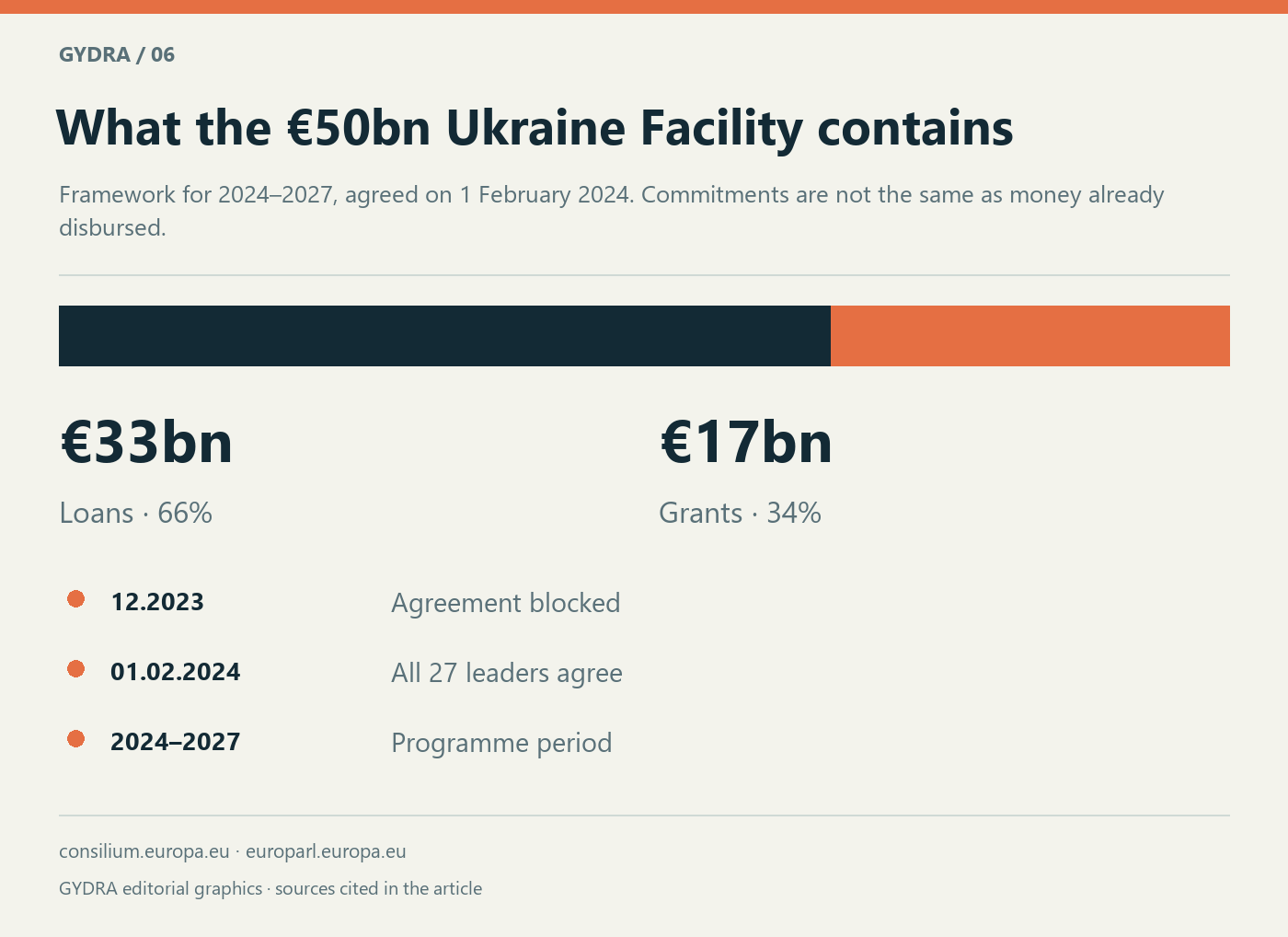
Viktor Orbán’s leverage is institutional as well as rhetorical. The dispute over the €50 billion Ukraine Facility delayed agreement in December 2023; on 1 February 2024, all 27 EU leaders agreed the package for 2024–2027. The sequence matters: a blockage and the later approval are both part of the record. On 30 June 2024, Orbán joined Herbert Kickl and Andrej Babiš in Vienna to announce Patriots for Europe. The initiative became a European Parliament group in Brussels on 8 July. Its creation documents political organisation, not a Russian financing transaction. 16 8 17 9
What the €50bn Ukraine Facility contains
Framework for 2024–2027, agreed on 1 February 2024. Commitments are not the same as money already disbursed.
Poland: shared domestic themes do not mean a shared Russia policy
Poland’s right is not a single actor. PiS, Konfederacja and the Confederation of the Polish Crown must not be treated as interchangeable organisations. Disputes over grain, the border or historical memory should be described through specific decisions and named speakers. The reactions to AfD discussed below include both approval and criticism on the Polish right. They are not a survey of Polish society. Similar positions on migration or EU institutions do not establish agreement over Russian security threats, much less a common source of money. There is also a concrete counterexample to blanket claims: on 24 February 2023, the Polish government reported Prime Minister Mateusz Morawiecki handing the first Polish Leopard tanks to Ukraine, during the PiS government. 18 19
United States: the media channel is a separate case
On 4 September 2024, the US Justice Department announced charges against two RT employees over nearly $10 million allegedly used to fund and direct a Tennessee-based media company. The department described almost 2,000 videos and more than 16 million YouTube views. Those figures show the alleged operation’s production and distribution scale, not the number of persuaded voters. They refer to the charged scheme, not a proven payment to an American political party or to AfD. The defendants were presumed innocent; the announcement itself was not a conviction. 20
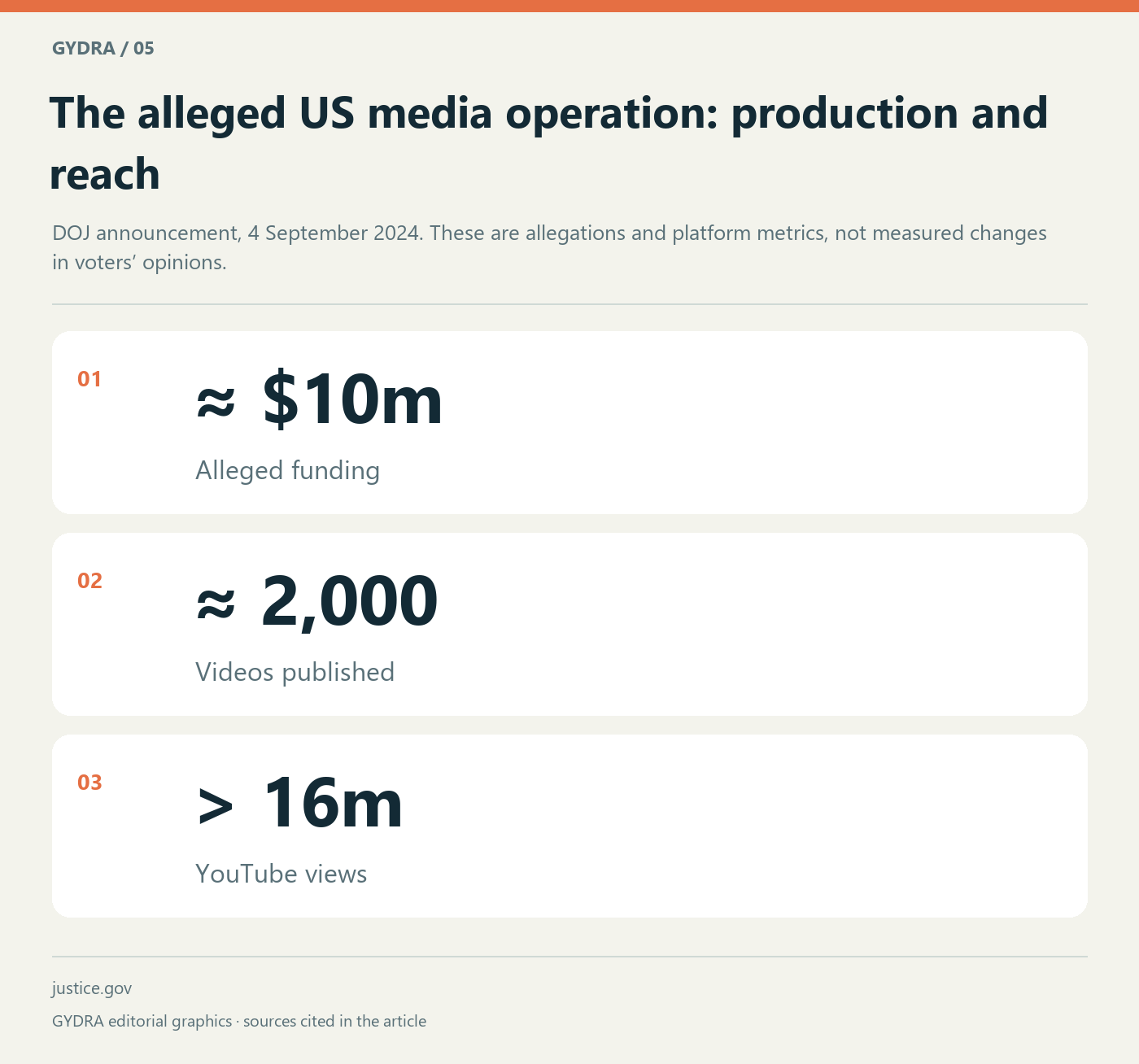
The alleged US media operation: production and reach
DOJ announcement, 4 September 2024. These are allegations and platform metrics, not measured changes in voters’ opinions.
Four amounts that must not be added together
The financial asymmetry is real, but it needs comparable measures. SIPRI’s figure of 137.2 billion rubles concerns Russia’s planned 2025 mass-media expenditure. It cannot be used as a total for covert influence, or compared directly with one Ukrainian international broadcaster’s spending. Ukraine does operate international media; a claim that it has none would be false. Without a matched Ukrainian budget and a common definition, this article does not invent a Russia-to-Ukraine spending ratio. 21 22
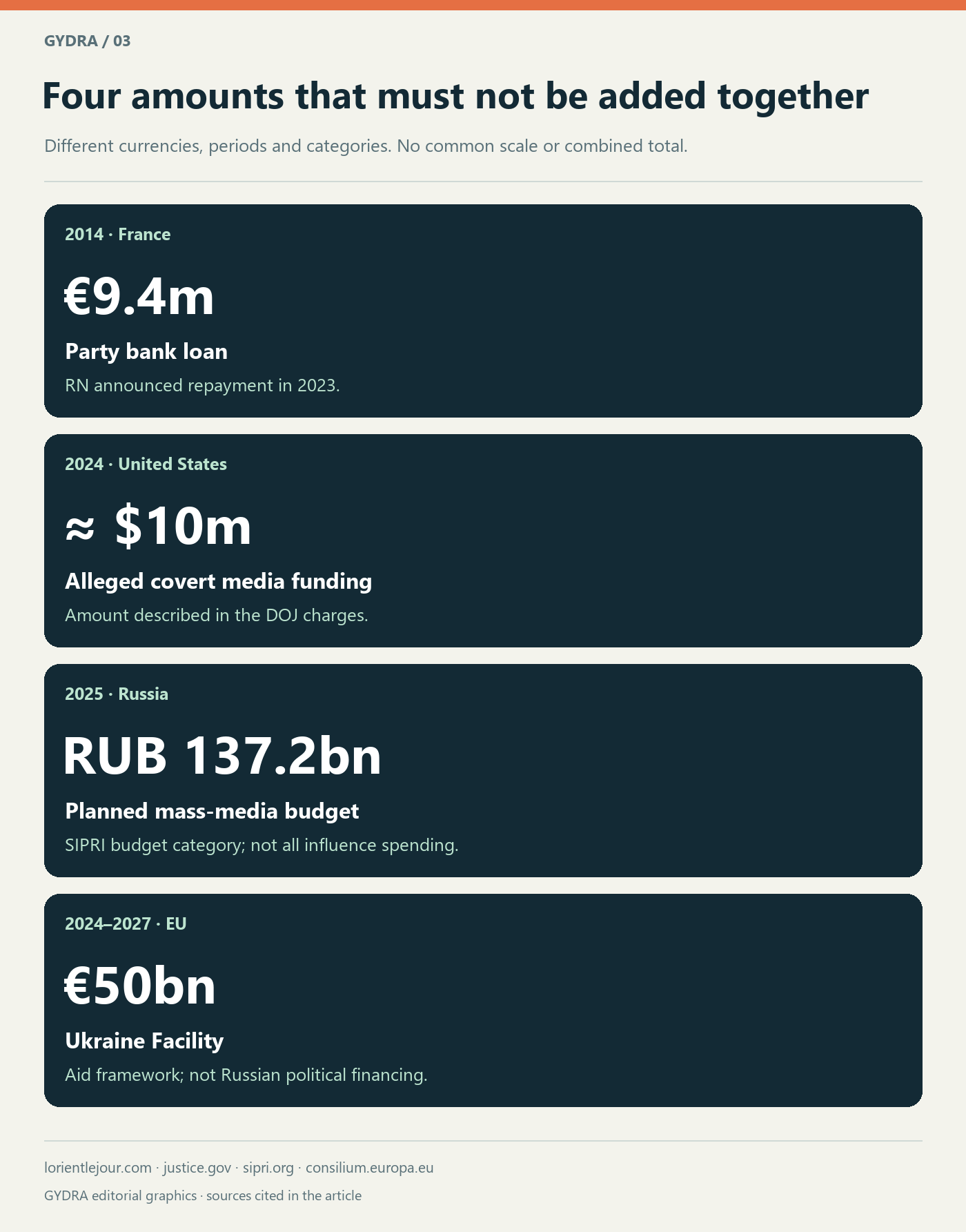
Four amounts that must not be added together
Different currencies, periods and categories. No common scale or combined total.
Germany and Poland: the current debate in detail
Alternative for Germany’s victory in the September 6, 2026 election was for the parliament of Saxony-Anhalt. It is an important regional result, but not a victory in a Bundestag election or a takeover of power across Germany. The distinction matters: a state parliamentary election result does not give the party sole control over German foreign policy. Election results — Saxony-Anhalt electoral authority; AP report.
There was no single reaction to this result in Poland. Jacek Wilk of the Confederation of the Polish Crown welcomed it. Zdzisław Krasnodębski called for an end to AfD’s isolation. Criticism, however, came not only from Donald Tusk, but also from Anna Zalewska of PiS and the head of the president’s cabinet, Paweł Szefernaker. The latter pointed to the party’s pro-Russian proposals. These examples reveal divisions on the political right as well; they do not support claims of widespread enthusiasm among Poles. Compilation of statements: Notes from Poland.
Offensive remarks: the speaker and context matter
The expression “the African Americans of Europe” recurs in this dispute. It is attributed to Fabian Keubel, an AfD activist and former member of the leadership of its youth wing in Saxony. According to a Polish Radio report of August 4, 2026, he used it in the context of commemorating the victims of the Warsaw Uprising in Berlin. The report also describes his mockery of Polish historical memory and demands for reparations. Polish Radio.
Accuracy requires two qualifications. The wording was “the African Americans of Europe”, not “the Africans of Europe”. It is a statement by a particular activist, not a quotation from the party’s programme. Keubel is not a member of the Bundestag. Attributing these words to all AfD members would be an unjustified generalisation. Criticism of the remark concerns the use of a comparison to demean two communities, not the name of an ethnic group itself.
What AfD’s programme says
AfD’s 2025 federal programme calls for lifting economic sanctions against Russia, repairing the Nord Stream pipelines and a neutral Ukraine outside NATO and the EU. The party justifies restoring economic relations partly by citing the importance of Russian energy to German industry. It also criticises joint borrowing and mechanisms for sharing financial risk in Europe, invoking the protection of German taxpayers. AfD programme, pp. 62–65 and 91–92.
This does not, however, amount to documented opposition to every form of assistance to all European states. Military aid to Ukraine, joint loans, EU funds and alliance commitments are separate matters. In June 2026, AfD’s parliamentary group again opposed accelerating Ukraine’s integration into the EU, citing corruption and the risk of escalation, among other factors. This is the party’s argument, not an independently established consequence of EU enlargement. Position of AfD’s parliamentary group.
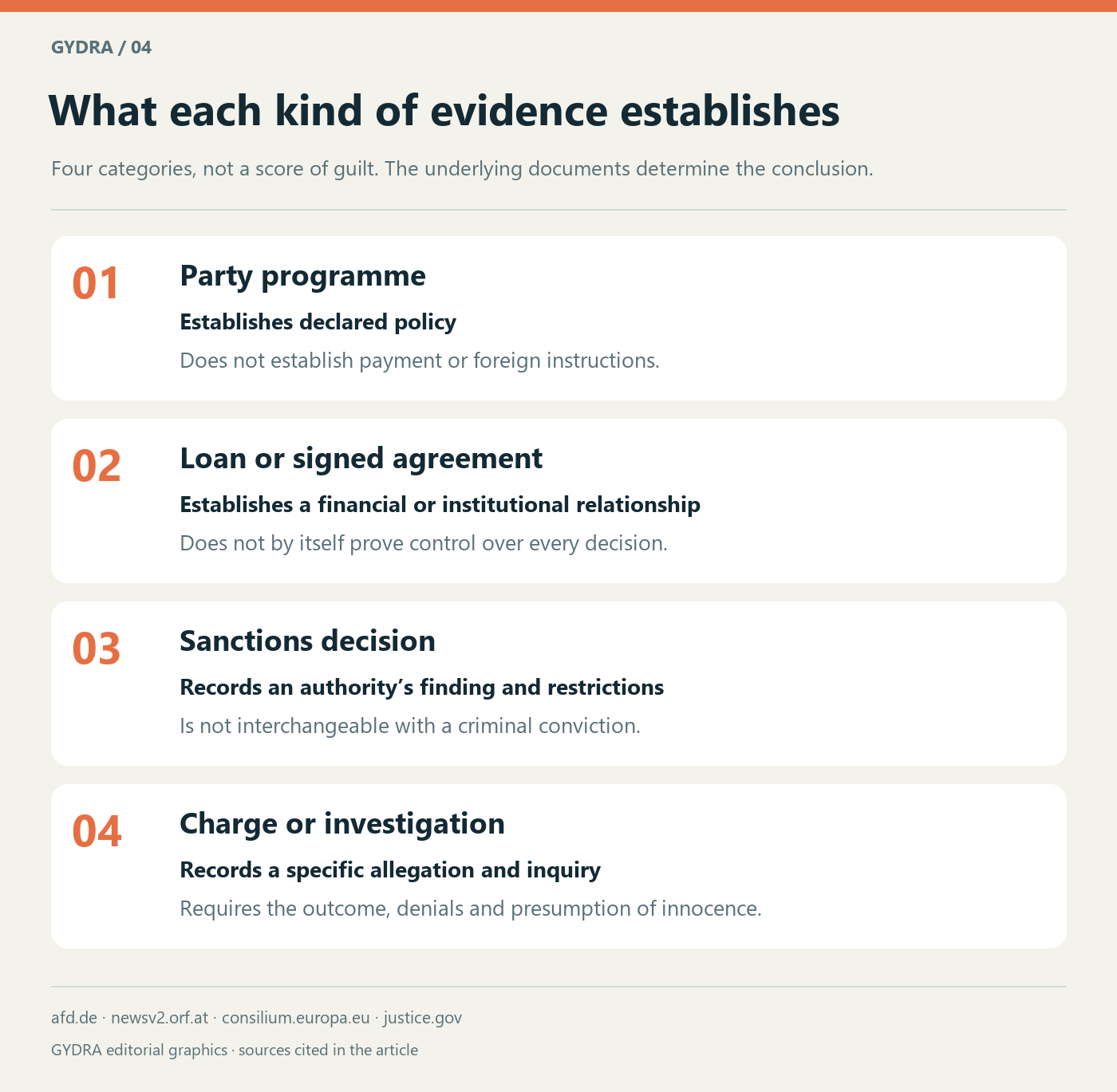
What each kind of evidence establishes
Four categories, not a score of guilt. The underlying documents determine the conclusion.
The political significance lies in decisions, not labels alone
The practical questions are concrete: who proposes lifting which sanctions, who can delay an aid instrument, who signs a party agreement and who receives money under a documented arrangement? Shared rhetoric can lower the political cost of cooperation with Moscow, while loans, media channels and institutional alliances create different opportunities for influence. But motives and effects must remain separate. A policy can benefit the Kremlin without its author being proven to work for it. The record is strongest when names, dates, contracts and decisions replace a blanket accusation against an entire political camp.
Sources and methodology
Each dated case refers to the linked source. Historical outcomes are not presented as current legal status unless explicitly stated. Graphics summarise selected cases and do not measure public opinion.
Share
Nothing is posted automatically: the link opens the chosen service's window, where you decide yourself whether to send the post.

Comments
0 commentsComments are public: every reader sees your pseudonym and your text. Your email is not shown. Reader links are marked as user-generated for search engines and pass no weight.
To comment, sign in or create an account. All you need is a pseudonym, an email and a password.
Sign in Sign upNo published comments yet.